Why Padel Glass Breaks. And Why It Doesn’t
Brevin Bennett knows a lot about glass. His company, Off The Glass, is unusual among padel-court manufacturers because it manufactures the glass it uses in-house in the United States. I asked Brevin to explain what makes padel-court glass…
Brevin Bennett knows a lot about glass. His company, Off The Glass, is unusual among padel-court manufacturers because it manufactures the glass it uses in-house in the United States.
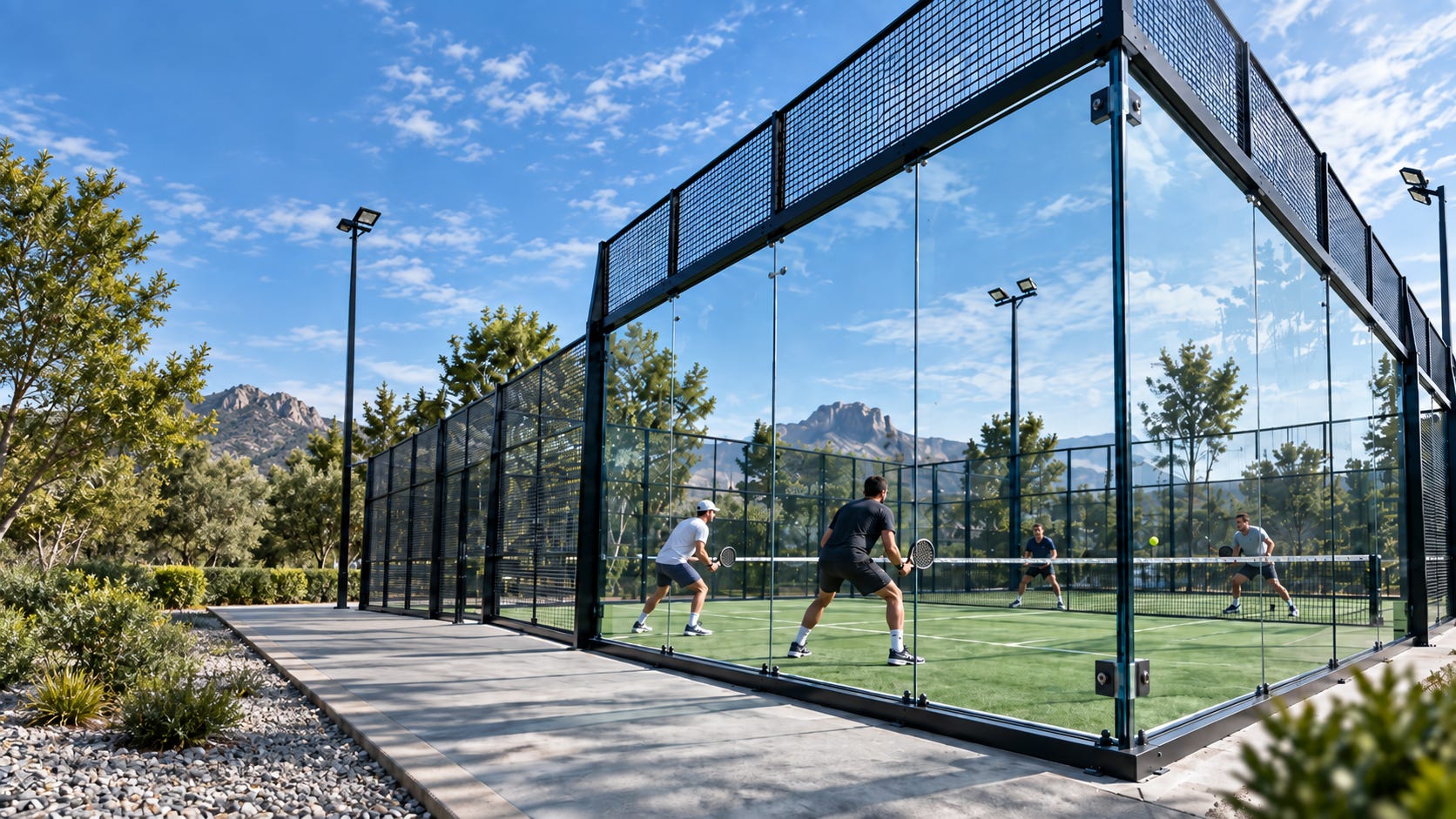
I asked Brevin to explain what makes padel-court glass unique and what goes into installing it as part of a padel court.
Q: What makes padel-court glass different from something like windshield glass?
Brevin: Each panel of glass for a court weighs roughly 380 pounds. We can usually install all the glass in about six to eight hours.
A standard padel court uses 12-millimeter tempered glass in a single pane. Monolithic glass.
Your windshield is laminated glass. It consists of two thinner pieces of glass adhered together with a film between them. When your windshield breaks, that film helps hold everything together.
Padel-court glass is more like the side window of your car. If your side window breaks, it shatters. It’s designed that way so that, in an accident, you can break the window and exit the vehicle.
Monolithic glass is like your side window. Laminated glass is like your windshield.
Glass is often misunderstood as a fragile material. It’s actually extremely strong. Twelve-millimeter glass can handle significant loads and pressure from non-sharp impacts.
If you stood a properly installed piece of padel-court glass vertically, there is no human being on Earth strong enough to break it simply by running into it with his body. If it breaks, something else is wrong.
What glass doesn’t like is having that force concentrated into a very small area — a bolt, sharp edge, pointed object or something like a car-window glass breaker. Glass becomes vulnerable when force is concentrated into a tiny area.
Q: What about plexiglass? Isn’t it stronger than glass? Why don’t padel courts use it instead?
Brevin: Plexiglass is very impact-resistant.
But when it comes to playability and long-term clarity, glass has some important advantages. Plexiglass, Lexan and similar materials can scratch much more easily. Glass is very difficult to scratch.
There are some courts made from plexiglass, but the feedback I’ve seen from players is that you don’t get as predictable or solid a bounce as you do from standard glass.
Q: I know there are regulations around how strong padel glass has to be. How do you test the glass to make sure it can withstand players running into it at high speeds?
Brevin: When it comes to testing, there are a couple of things we have to test.
Glass in its raw form, if it breaks, creates large, sharp shards. Tempering it is what makes it safety glass. Because we temper our own glass, we have to test that tempering process. So any time we change something in the production process — time, temperature or anything else — we have to break glass.
We randomly take panes from the production run, set them aside and break them. From that sample, we take the 10 largest pieces of broken glass and weigh them. They have to fall under a certain weight to qualify as certified safety glass. I don’t know that exact value off the top of my head.
But the pieces are very small — roughly the size of your thumbnail or smaller — with more dulled edges.
If tempered glass breaks, could somebody still bleed? Yes. The difference is that with tempered glass we’re generally talking about Band-Aids. With non-tempered glass, we’re talking about potentially significant injuries and lacerations.
Q: How do you test for wind load?
Brevin: Wind-load testing is done by referencing American building-code specifications. You take a prescribed pressure based on those specifications and conduct a professional engineering analysis in a modeled environment.
You take a 3D model of the court and apply wind-load forces from different directions to the glass panels. The analysis tells you how much deflection those forces will create based on how the glass is mechanically fastened.
For example — and this is just a fake number — the glass might move half an inch in a 100-mile-per-hour wind.
Then the engineer compares that result with the applicable building code and uses a professional engineering stamp to certify whether the structure meets the local requirements.
If I were advising you as an operator, I would make sure you were paying very close attention to the permitting documents and specifically whether the glass is actually factored into the wind-load calculations for the court.
Q: What do you mean? Isn’t the glass obviously part of the wind-load calculation?
Brevin: With most court manufacturers, it actually isn’t.
What that means from a permitting perspective is that, during a major wind event, the assumption may effectively be that you’re going to remove the glass beforehand.
Often, they’re calculating only the steel structure — sometimes only portions of the steel structure.
If you reference Austin Edwards’ article asking whether certain outdoor padel courts are legal, that’s essentially what I’m talking about.
Courts coming from overseas are often designed in countries where building permitting and codes are much less restrictive than they are in the United States. The models and engineering documents they’re bringing over are often calculating only portions of the steel construction and not accounting for the glass.
That is going to become a much bigger issue in the United States.
Q: So someone could have a permitted court where the engineering assumption is essentially that the glass comes down before a major wind event?
Brevin: Correct.
First published on Scott Matulis Padel.
Read it on Substack