
Two ACL Tears Ended Georgina Rosales' Padel Career. Los Angeles Brought It Back
A month or so ago I was at the Santa Monica Pickleball and Padel club to check out the 2026 LA Cup, an interclub tournament between LA-area clubs that’s been running since 2024. I was there to meet the people who are bringing padel to the…
Part One
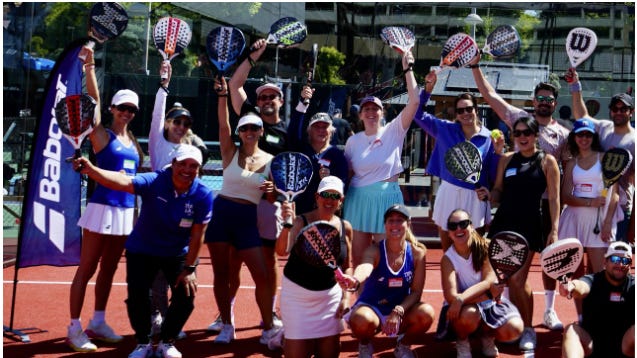
A month or so ago I was at the Santa Monica Pickleball and Padel club to check out the 2026 LA Cup, an interclub tournament between LA-area clubs that’s been running since 2024. I was there to meet the people who are bringing padel to the city. A guy I’d played with at Pura Padel named Nelton said, “You gotta talk to Georgie,” and walked me over to a couch between two courts that turned out to be the tournament’s control room.
Georgina Rosales was sitting on the couch doing about 200 things that had nothing to do with me. People were firing questions at her. “What court am I on?” “Where’s Dave?”
After a moment, Nelton introduced me thus: “He writes for Padel Nation and some other stuff.” It’s a good description, but I was basically a guy in short pants holding a notepad.
Rosales was running the show for the LA Cup. She was the tournament director. But she stopped what she was doing and gave me 15 minutes of her time.
That’s one of the reasons I freaking love padel. The people are terrific. It’s making me a better person.
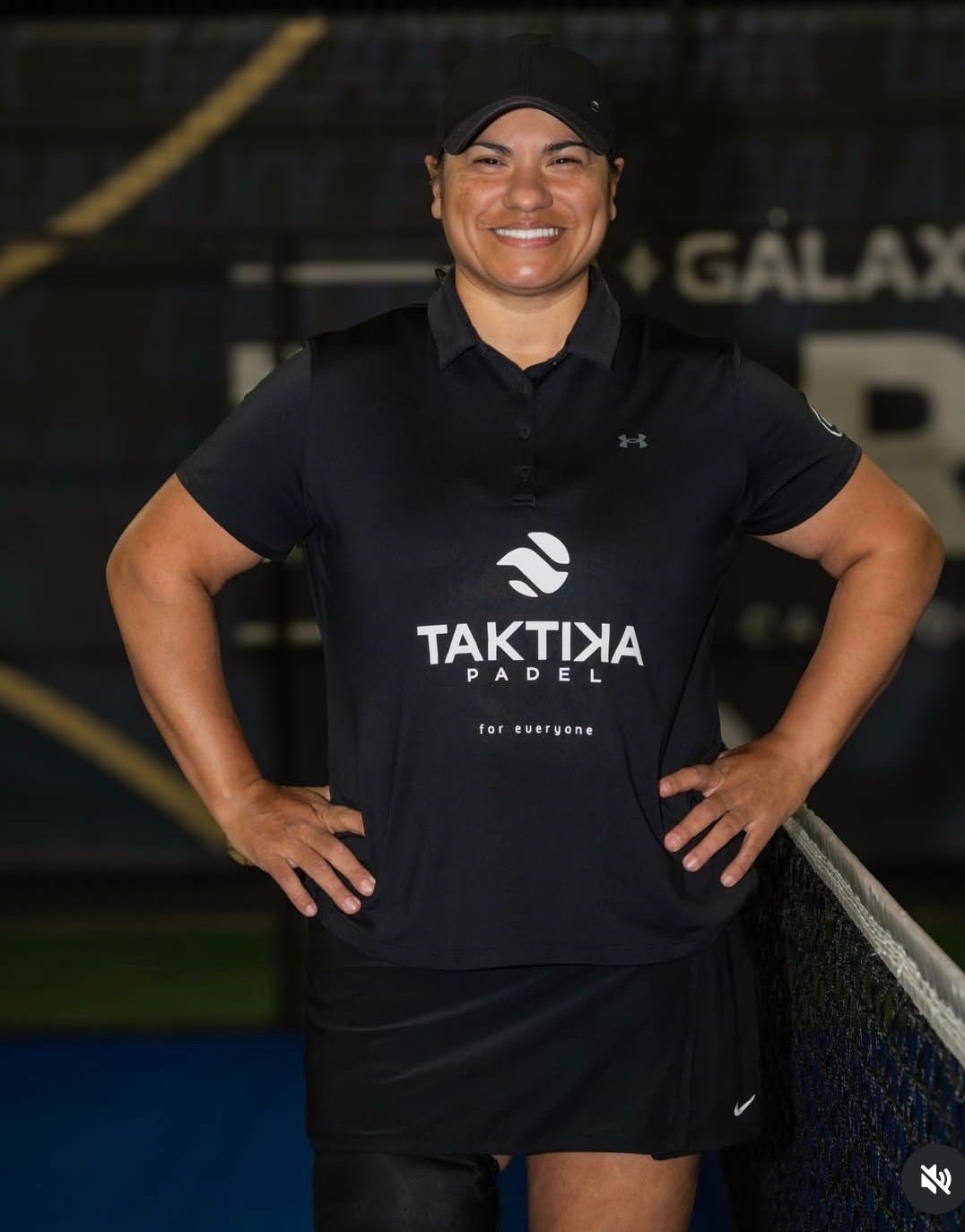
If you see this person, sign up for a lesson
As it turned out, Rosales took a long and twisty road to that couch she was sitting on.
She started playing padel in 1991 in Córdoba, Argentina. She was 12 years old, and padel was booming. A friend of her dad’s built a court, so she and her friends went to check it out. Like it does with a lot of us, the time between when she started playing and when she was ALWAYS playing was pretty short.
“At that time, the padel courts were made of brick,” she said. “The walls were brick, with no glass, and the court surface was concrete. It was totally different. For us, it became what we did every day. After school, we went to the club and spent hours and hours playing. It was me, my friends, my sister and the children of my dad’s friend. We spent hours and hours playing at the club.”
She won her first tournament when she was 12, partnering with her best friend, María José Antoniazzi. In 1994, she won a Junior World Championship in the 14–16 age division as part of the national team.
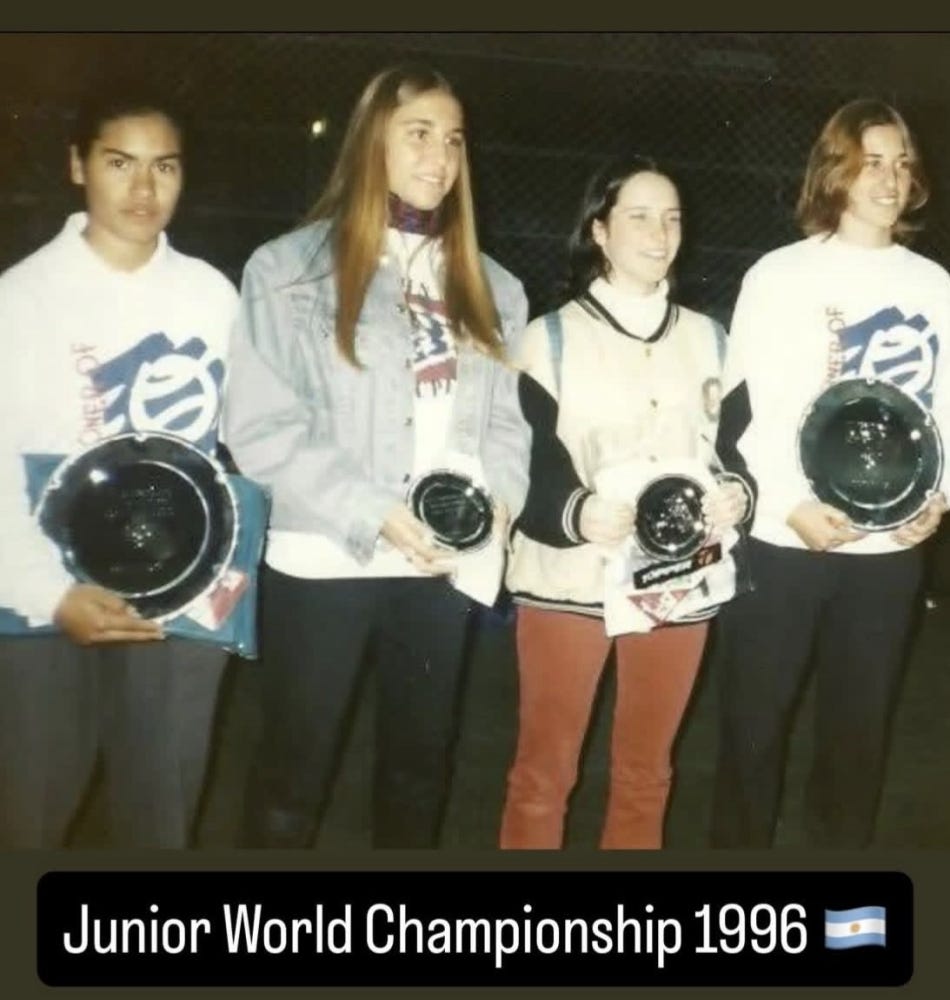
She’s the one looking straight into your padel soul
Rosales was a top junior in Argentina, but at 15, she suffered the first of several health-related career setbacks. She came down with rheumatic fever, an inflammatory illness that can affect the joints, heart, skin and nervous system. In Rosales’ case, it affected her foot.
“I was training and suddenly I couldn’t walk anymore,” she says. “I thought I had twisted my ankle. Weeks and weeks passed while I tried to recover my foot, but I couldn’t walk. I went to seven different doctors. Doctor number eight finally discovered that it was not a physical injury. It was a virus that had affected my joint.”
Her foot kept her on the sidelines for months, but it also led to one of the most important friendships in her life. Her mother obtained the phone number of Cecilia Baccigalupo, then the No. 1 women’s player in the world. Baccigalupo called Rosales and left a message of encouragement on the family’s answering machine.
“You’re going to get well,” Baccigalupo said. “You’re going to be okay. Keep it up. We’re going to meet you soon at the court again.”
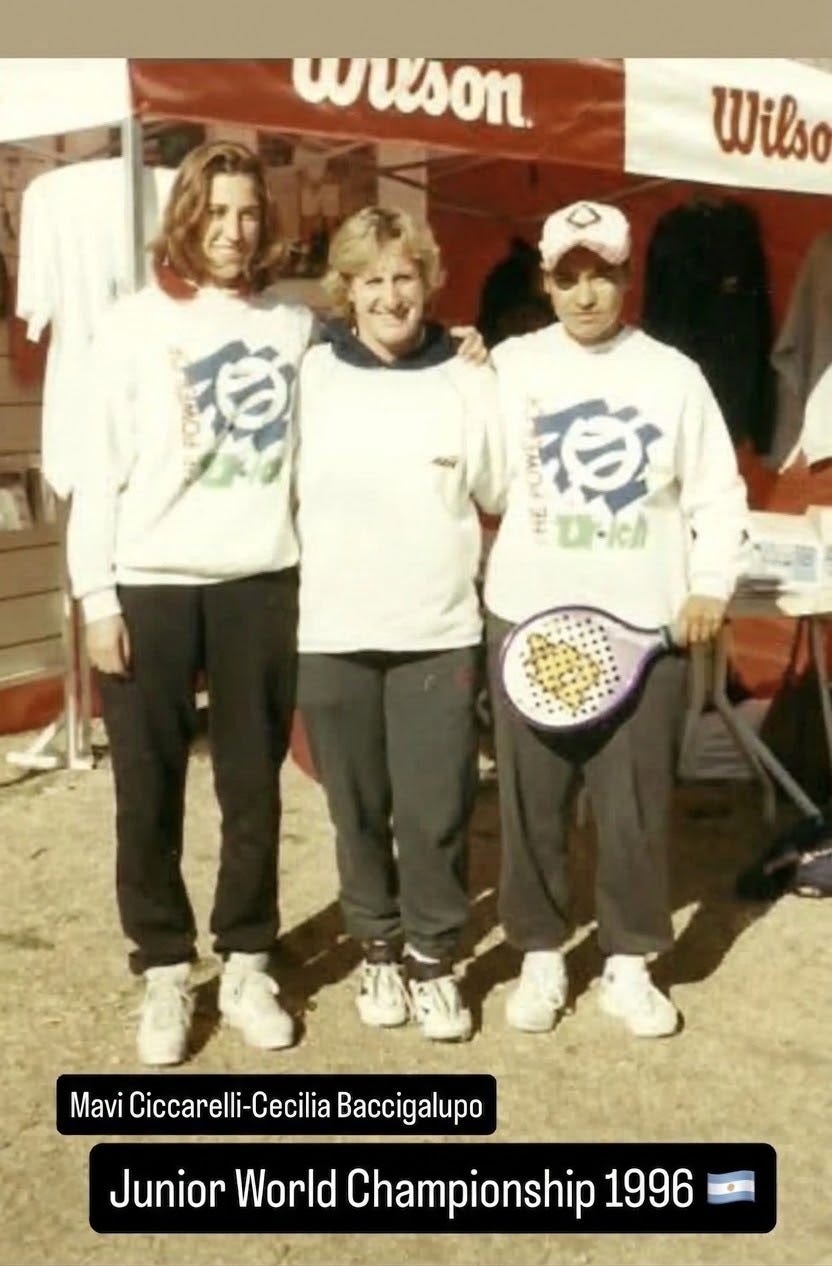
And they would. Rosales’ first tournament after she recovered was the Junior World Championship in Buenos Aires, a tournament organized by Baccigalupo. Rosales won that tournament, partnering with María Victoria Ciccarelli. She met Baccigalupo and took a picture with her. But Rosales did not tell her that she was the kid who had received Baccigalupo’s voice message, words Rosales had needed to hear. That came many years later.
“A few months ago,” Rosales told me, “I had the chance to meet her again, and I shared the story with her. She was super happy about it, and I was super happy to finally have the chance to tell her.”
Rosales continued to play tournaments in Argentina throughout the 1990s with an eye toward trying out for the senior national team. In 1998, one week before national-team tryouts in Buenos Aires, she tore the ACL in her right knee playing handball at a farewell party her friends threw for her.
“My sister told me, ‘Don’t do it. It’s only one week before the tryouts for the World Championship.’ I said, ‘What’s going to happen? Nothing is going to happen.’
“It changed my life. I knew immediately that something was wrong. I remember the face of my coach when he saw me walking with crutches and my leg in a brace. He didn’t say a word. He sat down at the club with his face down. I started crying, and he started crying. No one said a word. We knew it was over.”
Rosales didn’t have health insurance, and her family didn’t have the means to help her out, so having surgery immediately was not happening. She waited six years. She played zero padel, developed severe arthritis anyway and began studying software engineering.
She finally had surgery in 2004, rehabbed her knee and, against the odds, returned to professional padel. From 2010 through 2013, she competed on Argentina’s women’s circuit, playing in the same league as top players including Virginia Riera and Aranzazu Osoro.
Then she tore the same ACL again.
“I wasn’t even playing padel when it happened,” she says. “I was sitting at a desk and wanted to go to the restroom. My knee was locked, and I turned my body while trying to get up. That’s how it twisted and I tore it again.
“My doctor recommended that I not play padel again. He said that otherwise I would need a knee replacement, and a knee replacement 15 years ago was not the same as it is today. That was the end of my padel career—or that’s what I thought.”
Rosales accepted the doctor’s recommendation and retired from padel, focusing instead on building a career as a software engineer.
The thing is, the knee injuries that ended her padel dreams helped create the career that eventually brought her back to them in Los Angles.
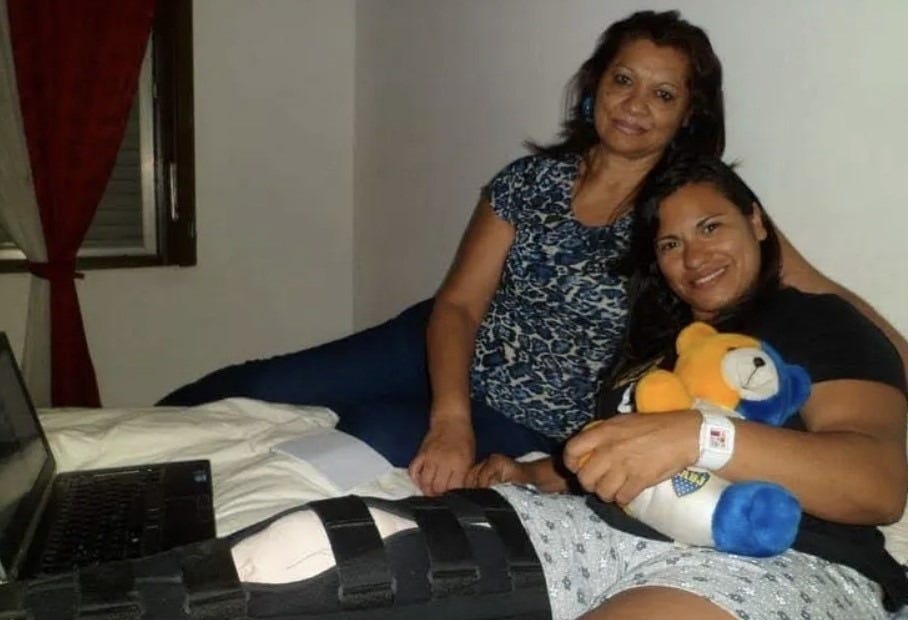
Rosales and her Mom/biggest fan
Part Two
Rosales joined a consulting company that sent her all over the world. She eventually ended up in the United States, even though that was “never in the plan.”
A consulting assignment with United Airlines brought her to Chicago, where she spent a year. She then spent another six and a half years in the New York City area before a project involving the LA Clippers brought her to Los Angeles. She worked as a product director on the fan experience for the team’s new arena, Intuit Dome. When that project ended, she began consulting for Ticketmaster.
In May 2025, she was walking around the mall in Century City with her goddaughter, who spotted an advertisement for Padel Up, a padel club that had just opened in the mall.
And this is the heartwarming part of the story, not so much about career-ending injuries.
“The courts were on the rooftop, so we had to take the stairs,” Rosales says. “At that time, I was almost 20 pounds heavier than I am today, and it was hard for me to climb the stairs. But I did it, and I went to the Padel Up courts at Century City Mall.”
She started following Padel Up on Instagram and quickly got a DM from Khadeejah Sani, founder of the only women’s padel community in Los Angeles, Chiquitas California, inviting her to play in their historic inaugural women’s USPA tournament.
I just interviewed Sani for another story, and she is just as awesome as Rosales. After pioneering the emergence of padel tournaments for women in Dubai, Sani has done the same for women in Los Angeles through Chiquitas California. She expanded her role in April 2026, accepting an offer to serve as the Southwest Regional Director for the National Padel League (NPL).
“We got Georgie back into padel last May at our first USPA 100,” Sani says. “I paired her with someone who was random at the time but is now a close friend. I’ve been blessed with having the sixth sense to partner up complete strangers who form a bond at our tournaments and remain in each other’s lives for years to come.”
“Without thinking, I said yes,” Rosales remembers. “Khadeejah paired me with another Argentinian woman named Lara. It was the perfect match and the best partner for me. But then I thought, ‘I need to share my story with her because I’m crazy. I don’t know if I can play.’ I told her, ‘I don’t even have a racket. I don’t have tennis shoes. I don’t know what I’m doing, but I want to be part of this.’”
Rosales went to a doctor who cleared her to play. She borrowed a Head padel racket from Sani, bought a pair of padel shoes and played the tournament. She and Lara won their first match, Rosales’ first in 13 years, against players who were much younger.
“In the second match,” she says, “I could barely move, but I was so happy and emotional. I said, ‘I want to do this, no matter what. I love the sport. I want to keep playing.’ Since that day in May 2025, I haven’t stopped playing.”
Rosales started playing at Taktika Padel in Carson, and before long she started coaching there as well, in the evenings after she got off work. When Jon Neeter opened Santa Monica Pickleball & Padel, he reached out and hired Rosales to coach there, too.
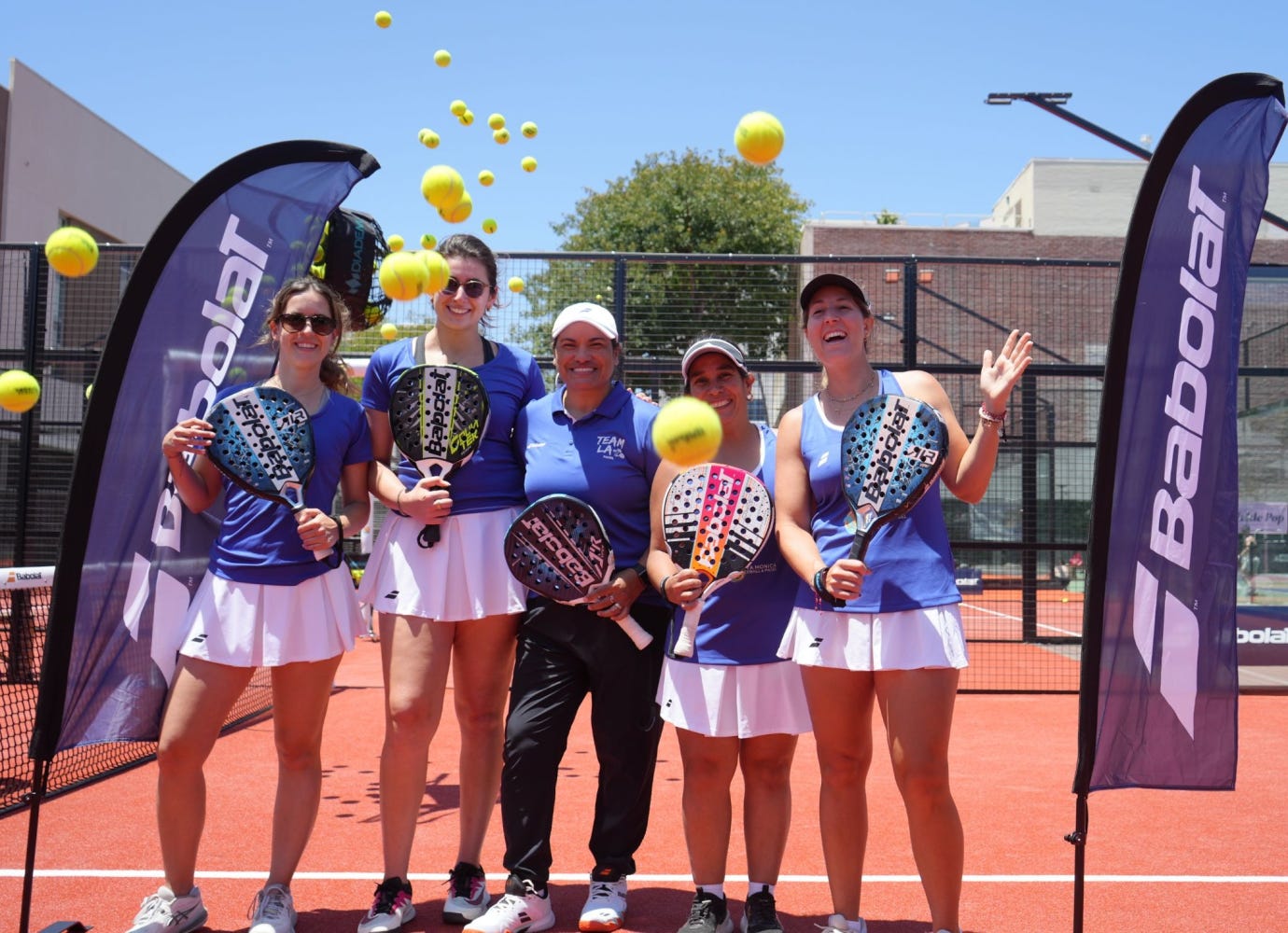
After captaining a Chiquitas California team in the NPL regionals last year, Rosales founded her own NPL team, Team LA, composed of women from across the LA metro area regardless of which club they played at. She also lined up a roster of sponsors, including Babolat, Santa Monica Pickleball & Padel, Zero AI and Victory Padel, to help defray the costs of competing.
At 47, after overcoming three soul-sucking setbacks, Rosales is back living her padel dream. In addition to working full time as a coach at Taktika and Santa Monica Pickleball & Padel, she’s taking a four-month Argentine coaching certification led by, of all people, Baccigalupo.
Team LA went to San Diego in June, won the regionals and qualified for nationals. At nationals, Rosales and Team LA advanced to the final, where they lost to a team from Austin, Texas.
“We did an amazing job,” Rosales says. “We are top two in the country now, and that’s something I’m really proud of.”
A week ago, Rosales invited me to Taktika to meet Baccigalupo, who she’d brought to the U.S. so American padel players could meet her. We all did. I interviewed her for an article that I’ll post here shortly. She’s amazing too.
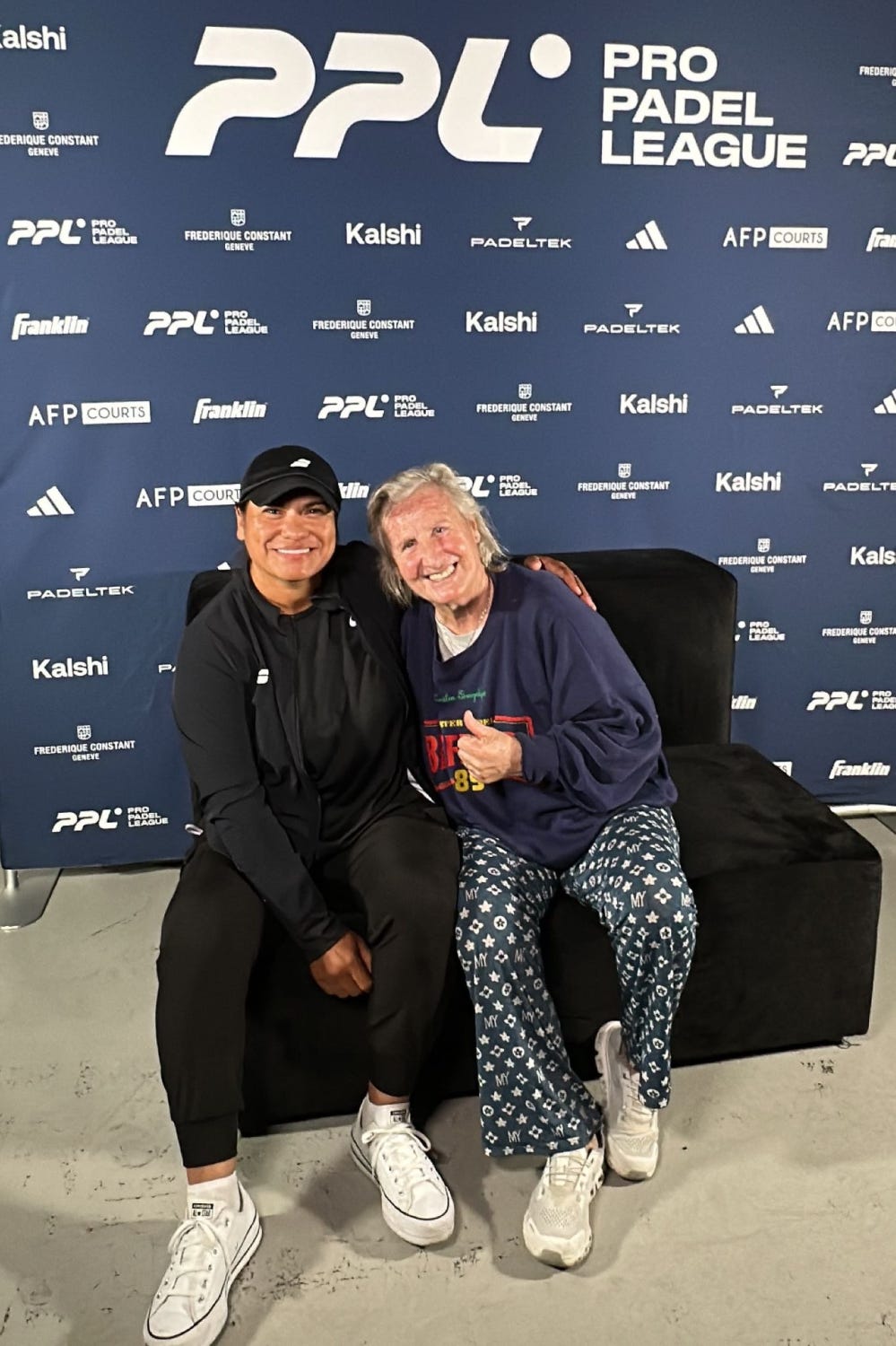
Georgina Rosales and Cecilia Baccigalupo
First published on Scott Matulis Padel.
Read it on Substack