
This Could Be You
Have you ever wondered who wins padel tournaments? I did. And now I know. Jose Romero does. A few weeks ago at the Padel UP USPA 500 event in Culver City, on Friday, prior to losing my first match, I saw this guy warming up with his…
Have you ever wondered who wins padel tournaments? I did. And now I know. Jose Romero does.
A few weeks ago at the Padel UP USPA 500 event in Culver City, on Friday, prior to losing my first match, I saw this guy warming up with his partner and he looked familiar. Then it hit me that I recognized him from the tournament two weeks earlier at my home club in Las Vegas. When he stopped for water, I introduced myself and asked him if he was there.
“Yeah, I was there,” he said. “I won that one. Division Three.”
He said it like he was a little embarrassed, not like he was bragging. On Sunday, I ran into him again and asked him when he was playing his next match.
“I’m finished,” he said. “I won Division 2.”
He showed me the bottles of mezcal and tequila they’d given him and his partner for the win. Turns out he’s only been playing padel five and a half months. Which kind of pisses me off. That’s when I decided to write about him.
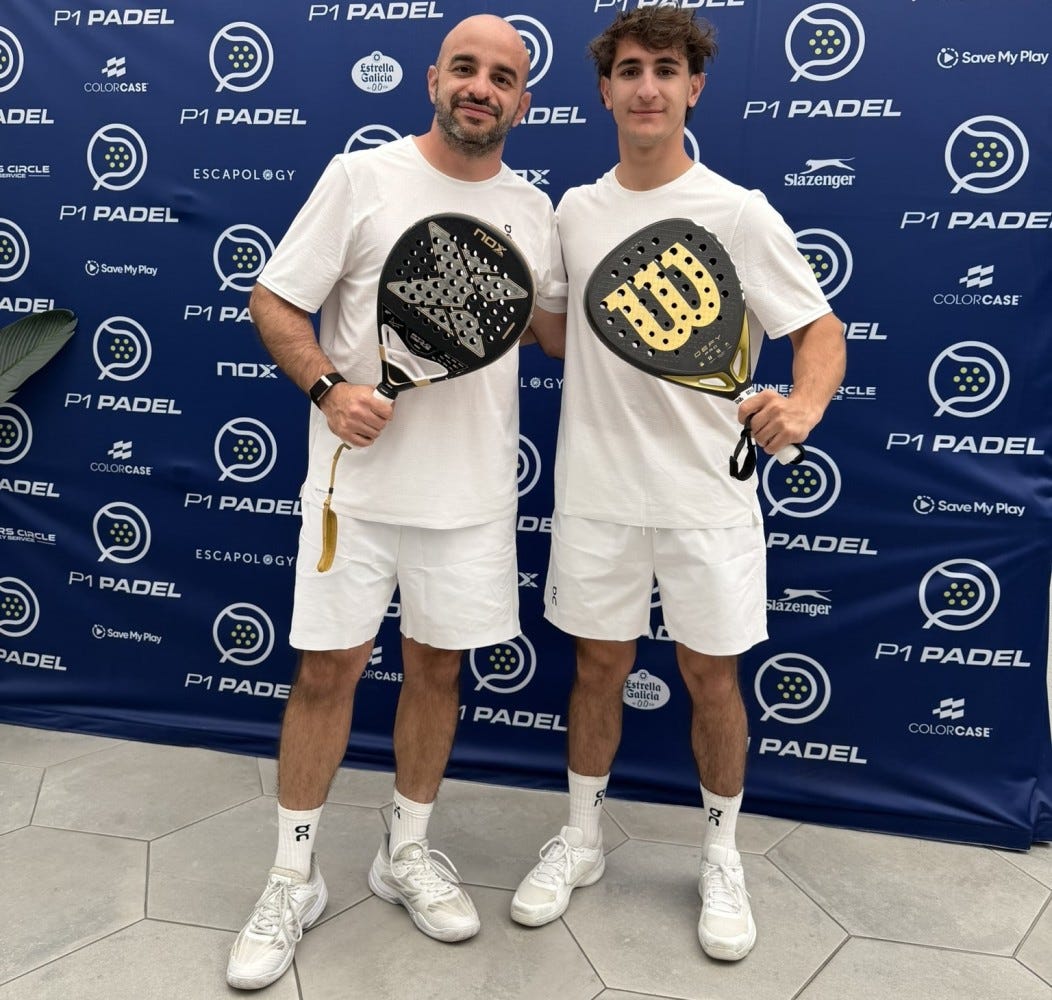
“I grew up in Venezuela,” Jose explains. “I started playing tennis when I was 14 years old and got to like the top 50 by the time I was playing the 16s and 18s. Then I competed, including some tournaments in South America, until I was like 22. I also gave tennis lessons. In high school and then starting college, I was teaching tennis in an academy at the Universidad Metropolitana in Caracas.”
Jose was good enough to play college tennis in the United States. He was having conversations with several schools, but life got in the way. Jose says he became involved in opposition politics in Venezuela, attending protests with María Corina Machado, the Venezuelan opposition leader who won the 2025 Nobel Peace Prize. He says that activism, and the injuries he suffered due to it, eventually led to him giving up tennis.
Jose completed his mechanical engineering degree in Venezuela and landed a scholarship to earn a master’s degree at the University of Maryland, which he accepted. While he was there, Apple reached out to him on LinkedIn and offered him an internship, which he also accepted. He finished his master’s in Maryland and headed west to California.
Today, at 33, he’s still at Apple, working as a hardware reliability engineer, making sure Apple products last like they’re supposed to. But while Apple pays him, he tells me his real job is “entering and winning as many padel tournaments as I can.”
Jose discovered padel when a friend from Venezuela invited him to Texas to watch him play a tournament. That was August of 2025. Jose had started playing tennis again, but had never stepped on a padel court at that point.
“I went to see this tournament, and nothing happened. I was like, ‘Oh, that’s cool.’ But then in December, one of my best friends from Spain came to visit. He says, ‘Let’s play padel. There’s a club near you.’ I said, ‘Let’s go.’ They loaned me a racket, and the front desk person taught me the rules: these are the rules, this is how you hit. Ever since, I’ve been obsessed with it.”
So you might be thinking, well, that could be me. That could definitely be me. I didn’t play college tennis either. I’m obsessed with padel too.
This is why it’s not you. Or me.
Jose plays padel nonstop. Way more than me. Way more than you, unless you’re Vinnie Di Francesco or live in Argentina. He’s got a merry band at Bay Padel in Sunnyvale that beats the crap out of each other daily, and the competition is one of the reasons he’s winning tournaments.
“Usually, I do two private classes a week, and I play every day. I organize my weeks almost three weeks in advance because I need to find times that match up with work and my dog. My dog needs an hour of exercise. When do I finish work? Who is going to play? It’s funny. I have a little note, day by day, of who I’m playing with, what time, what day, if I have a tournament, rest days, all of that stuff. I play every day, even though I shouldn’t.”
Jose also employs the latest technology in pursuit of improvement. He uses ChatGPT to improve his diet in a way that will make him a better padel player and keeps him away from Cinnabon. He’s got a fancy impedance measurement scale that lets him track his weight and body fat. He’s also got a Whoop fitness tracker and an Apple Watch. Bay Padel, where he plays, installed Clutch cameras on its courts to automatically record matches, generate highlights, livestream matches and, most importantly for Jose, track in-match stats. He shows me how it works. It’s nuts.
“It provides AI insight into your games, positioning, shot placement, and where your errors are,” says Jose. “So I feed that stuff into my AI, and I compare myself game by game to see if I’m improving based on the data. When I have the metrics, I say, ‘Okay, you’re missing most of these balls that are bandejas cross-court,’ or whatever it shows me.”
Jose then takes the Clutch data and feeds it into a Titan ball machine, a premium app-controlled ball machine that lets you program drills to work on specific shots. Jose employs the newest Titan Drills Pro app, which gives him more customization options and a better drill library than the previous version did.
No wonder Jose is beating guys who beat you and me.
But he’s not some cyborg, some Todd Marinovich or Ivan Drago bred specifically for athletic domination. He’s 5’9”. His back is better than it was, but he still has to spend a lot of time stretching, rolling, and grinding out recovery work with a chiropractor. And both the Clutch data and Alvaro, his coach and doubles partner, tell him he needs to work on his bandeja.
Just like you do.
“I miss a lot of them half-court, in the middle of the court,” he explains sheepishly. “My coach says, ‘You hit too many bouncers off the glass. They’re going to kill you with that ball bouncing like that.’ So it’s fixing it so it doesn’t bounce that much. That’s the biggest one. Hitting on the side is counterintuitive too, because in tennis you never hit on the side of the body, or the ball path, or whatever. That’s why I hit it too high, and then the ball bounces too much and I get in trouble.”
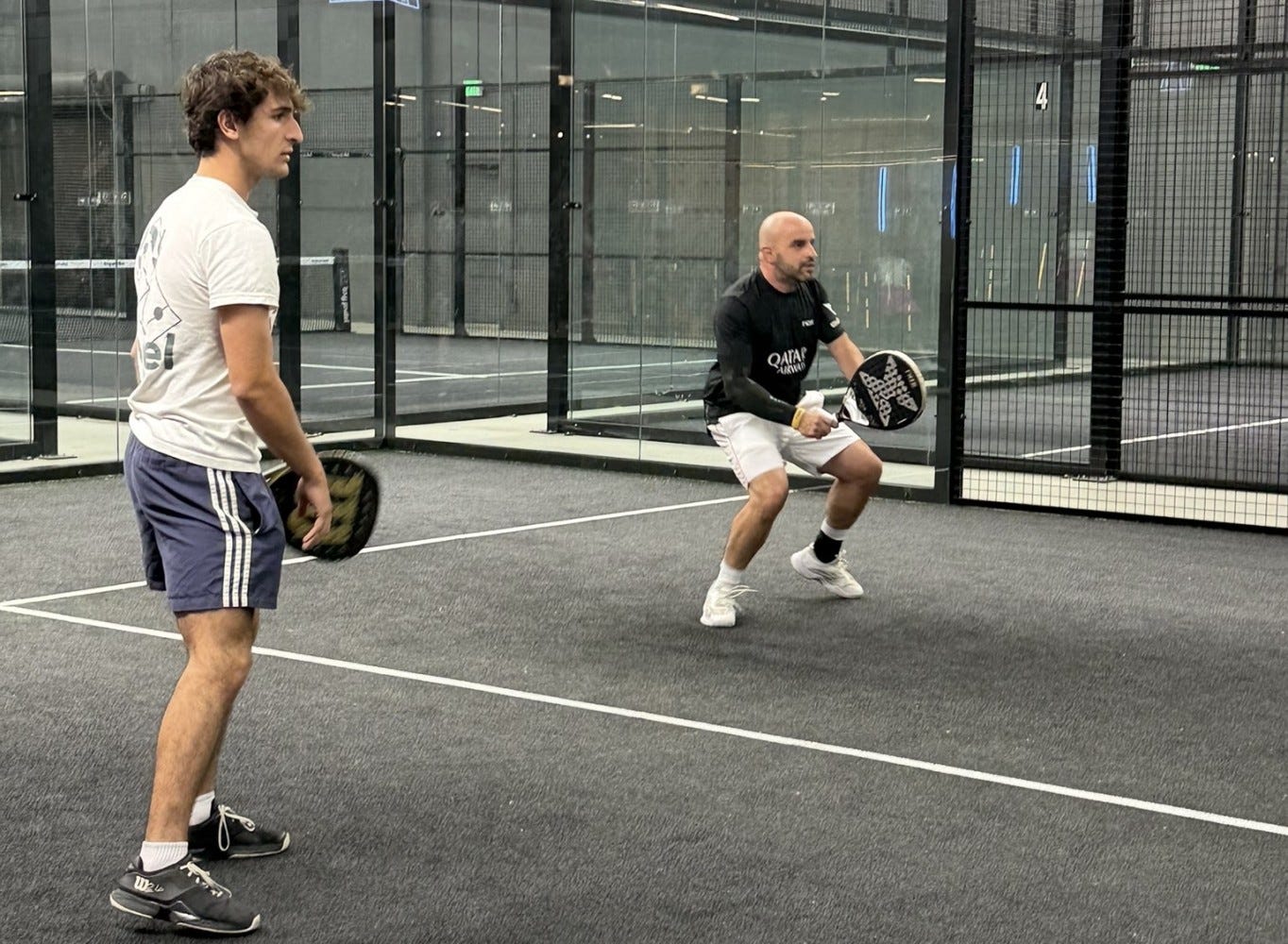
When he’s not at Bay Padel, Jose’s on the road playing tournaments. Unlike you and me, Jose has maxed out his allowable vacation-time accrual and works for a boss who supports his padel dream and allows him to take Fridays and Mondays off for tournaments, which he often does.
The first one was a few months ago in February, and it went about the same way my first tournament went in Culver City, but for completely different reasons.
“We got whooped,” Jose smiles. “It was my first outdoor tournament, and it was a disaster. Everybody had sunglasses. I didn’t have sunglasses. I had the sun in my eyes. The wind was moving the ball, and I was nervous because it was my first tournament. It was bad. But I learned a lot.”
He played two more small tournaments and then entered the P1 Padel USPA 2000 in Las Vegas, which, as I said, he won. He was slated to play the Cooley USPA 1000 event at Padel N9ne in San Diego last weekend, but had to sit it out due to a wrist injury. He went anyway to coach up a couple of his friends. Before he tweaked his wrist, his upcoming schedule looked like this:
-
USPA 500 – Park Padel SF – June 26
-
USPA 500 – Chiquitas LA – July 10
-
USPA 2000 – NY Padel Haus – July 24–26
-
USPA 500 – Tucson AZ – Sep 18
-
USPA 250 – Chiquitas LA – Sep 26
-
USPA 500 – SF Bay Padel – Oct 30–Nov 1
-
USPA 2000 – X Miami – Nov 20–22
I’m not playing all those tournaments. Are you?
And look, he’s not the Bryan brothers, either. He plays with different partners at different events. Some of his partners are tennis players and some are padel players. The guy he won Culver City with was a tennis player who also plays a little padel. Jose has learned to adapt his game to fit his partner.
“It’s interesting because in the tournament in L.A., I played with Carlos. Yes, he plays padel, but he’s a tennis player 100 percent. My partner in Vegas, Alvaro, is a padel player. He doesn’t play tennis at all. So it’s a big shift. With Carlos, it’s just hitting it hard at the person, hitting hard to the chest. He doesn’t let the ball bounce to the glass. When I play with Alvaro, it’s completely different. There’s a lot of patience: let it bounce, lob, chiquita here. So it’s a completely different game.”
So look for Jose at a tournament near you. He’ll be there, probably holding a trophy. Go say hi. He’s just like you. Kind of. Well, not really. But he’s a super nice guy and he’s got the same goals you and I do when it comes to padel.
“My end goal is to improve and keep improving as much as I can. When I first started padel, I would see some guys and think, ‘Wow, these guys are good. I want to play like them. I want to be able to compete with them.’ Now, I can do that. I see progressive improvements every week, and I want to keep maximizing that and not stop. My goal is not necessarily to be the best in Division 1 because I’m not that young. But I want to be able to compete at that level and have fun and meet people and be competitive.”
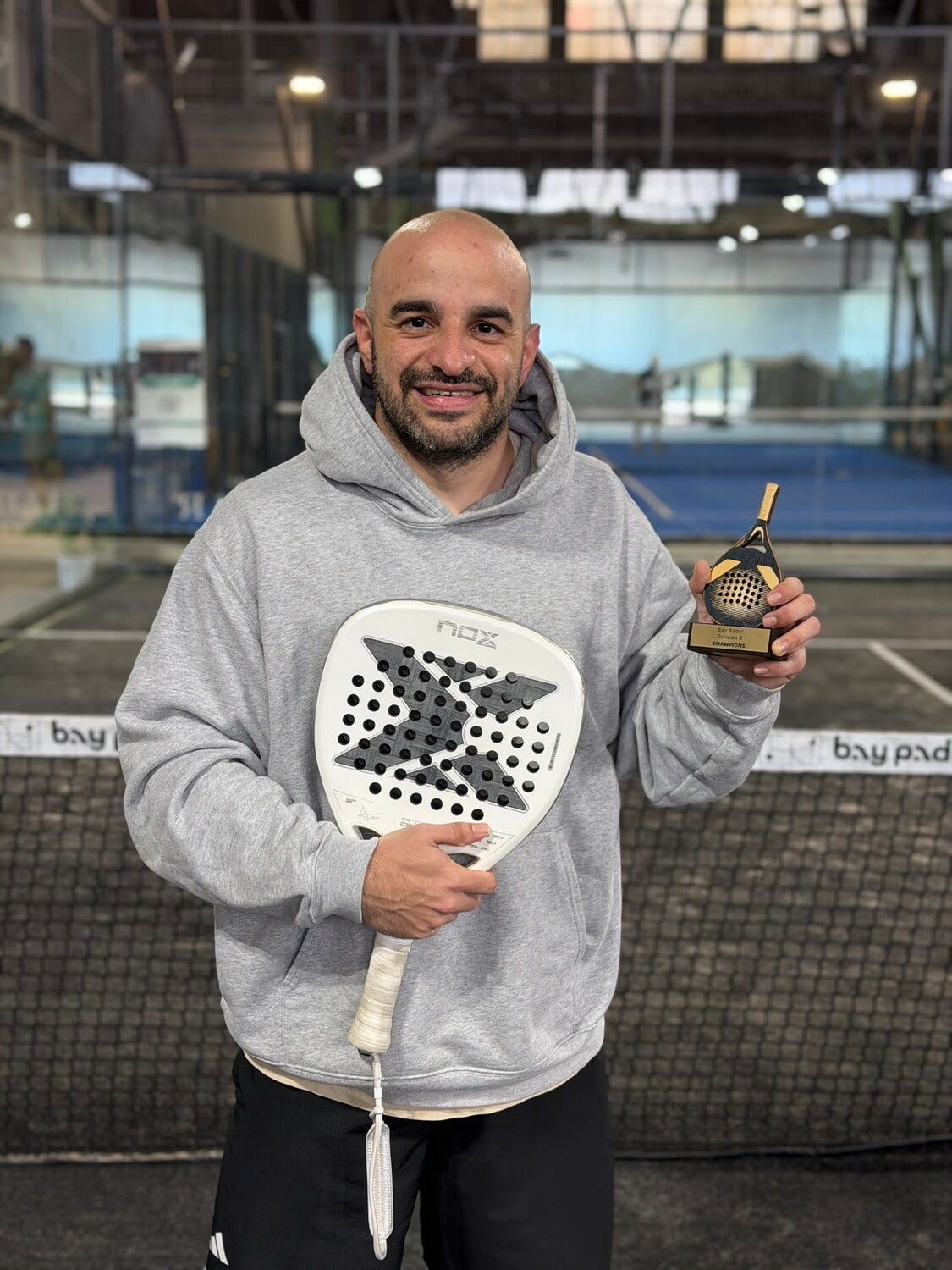
Jose looks like this. Holding trophies.
First published on Scott Matulis Padel.
Read it on Substack