
Marcos del Pilar Is Not Fooling Around
My RSPA padel certification weekend in Salt Lake City
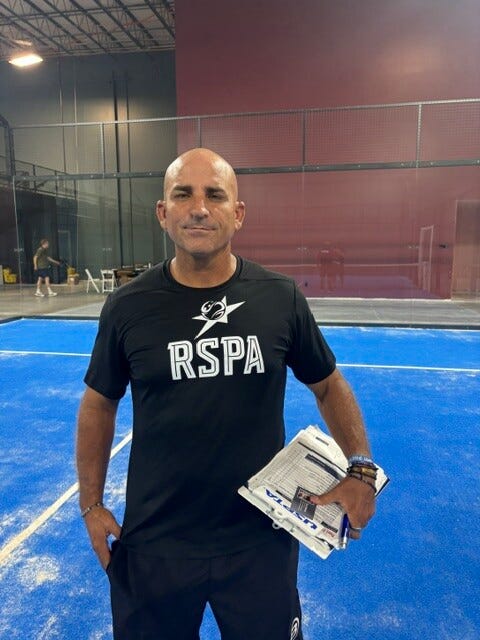
Marcos del Pilar is not fooling around. I know, you watch his videos, see the zany Instagram images of him with the students he turns into padel coaches, and you get the idea that this guy is a showman. A pitchman. He’s got that high voice, even higher energy and a smile that draws you in. He’s engaging, he’s charismatic and he says funny stuff. I dig the shape of his head.
Don’t be fooled though. Marcos del Pilar is serious about what he does. Padel is not just his passion. It’s his business and he takes it extremely seriously. He’s an instructor, an entrepreneur, a hospitality executive and everybody I’ve asked says he’s done more to grow padel in this country than anyone else.
And it’s not close.
I just spent two days with him in Salt Lake City at an RSPA Level 1 padel instructor certification workshop. Del Pilar runs the padel show for the RSPA. He writes the certification curriculum and conducts workshops all over the country, growing the number of instructors ready to teach Americans how to play padel, and of course to explain to them what the heck it is.
Over the course of the workshop, I learned this: Even when he’s smiling, which he almost always is, and even when he’s joking around, not a word comes out of del Pilar’s mouth that doesn’t have a purpose. A meaning. Pay attention or you’ll miss something important.
“I use jokes a lot,” Del Pilar told us. “Because people remember them.”
They do.
For example: He said, “When they lob you, they’re trying to see how stupid you are.” Funny, right? Also, on the mark. What he’s saying is that when your opponent lobs you they are trying to see what kind of bad decisions you make. “They are testing your level,” del Pilar explained, “by seeing whether you smash appropriately in a bad situation or if you decide to play neutral until you are in a more comfortable spot.”
Right?
Pay attention.
Saturday
If you want to get certified to teach padel by the RSPA, you have to attend a workshop. Before that, you must complete about 15 hours of online lessons covering everything from how to hit a bandeja and how to teach a group lesson to how to feed balls using rubber tubes and fanny packs instead of ball hoppers.
The online courses also provide tips on how to run and grow your padel coaching business. Del Pilar teaches every lesson himself. For the workshops he sometimes brings in folks on his team, padel notables like Nico Agritelley, Moose Bayoumy, Iñaki Calvo and Jorge Vila depending on where the workshop is being held.
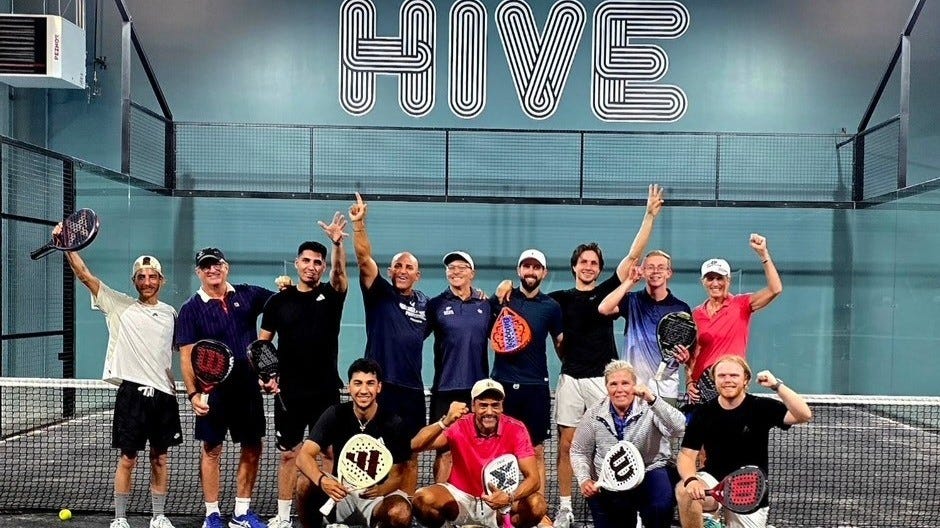
The workshop I attended in Salt Lake City took place at the not-quite-open padel club The Hive. When it opens in September, The Hive will be the seventh club in the Salt Lake City metro area and the first dedicated padel club within the city limits. And based on what I saw, it’s going to be amazing. Five indoor courts, 30-foot ceilings, a sizable viewing platform, a cafe, some of those crazy big ceiling fans you see in EOS health clubs, and an air conditioning system that cannot be beat.
My workshop featured 12 participants. We met at The Hive for a 9 am start on Saturday. The first two folks I met were Maureen, who runs a local pickleball program and Mattias, a French former professional squash player, who would kick my butt, and I suspect, mock me while doing so, several times throughout the weekend. Maureen said, “Call me Mo.”
Other classmates included Mal, who played and taught seemingly every racket sport there is at a club in Sun Valley, Idaho; Debbie, who played Wimbledon and the US Open back in the day; her son Connor, a pro tennis player; Chris, whose wife had given him the workshop as a birthday present and, two young guys who worked for other padel clubs in town.
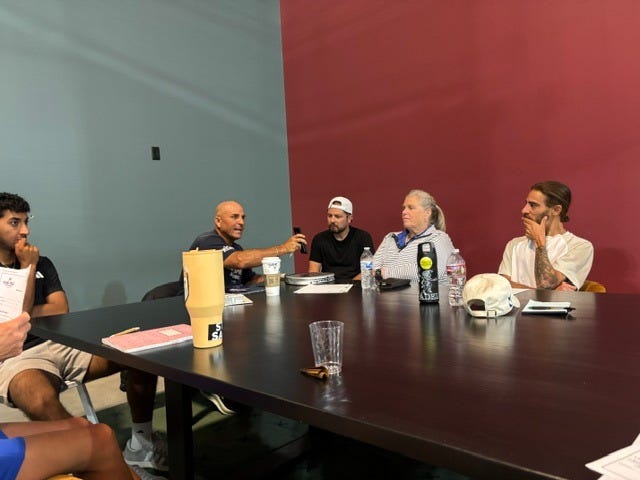
Del Pilar convened the workshop around a table next to the courts. The Hive brought in muffins, water and other breakfast stuff and we dug in as del Pilar spent an hour and a half going over the program.
“I’m doing this with a lot of love.”
There would be three parts to the certification process. First, we would each teach a lesson. Then there would be a stroke test, then a feeding test.
He also told us up front that he was very sorry if we didn’t pass. “I’m doing this,” he said, “with a lot of love.”
By the time he led us onto the courts, he had us FIRED UP. There was an energy, man. Nobody was there checking out teaching padel as something they could do in their spare time. Nobody was there on a goof. Nobody was treating this as just another job.
Each of us had become obsessed with padel at wanted to do something life changing. We all wanted to learn from Marcos. Honestly after a couple of hours, we wanted to BE Marcos. He’s that compelling.
We were like those suckerfish that stick themselves to the undersides of sharks hoping to grab some scraps when they eat.
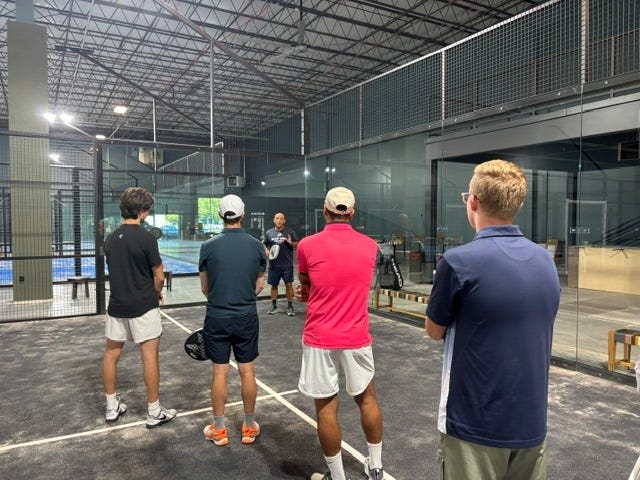
For the rest of the day, we rotated between on court instruction and off court skull sessions.
Marcos waxing large in Salt Lake City
Del Pilar’s thing is that you have to find your student’s “Big Why,” their pain point, the reason they’re paying 100 bucks for an hour with you. During each lesson, students should be “having fun with a purpose.” And remember, padel is the hospitality business. Show up early. Look professional. Be engaging. Use clear language that beginners can understand.
When he’s talking about teaching beginners, Del Pilar uses both his wife and his mother to get his points across. “I use my mother,” he says. “She’s terrible at padel. Would she understand this? How can I teach this concept so she would understand?”
Del Pilar stressed that our job was to evoke emotions in our students via padel.
“We have to create a feeling,” he stressed. “Nobody will remember how you teach the forehand volley. They will remember the way you made them feel. The best business card is word of mouth.”
The way to teach good lessons and build clientele, he reiterated over the course of the weekend, is to make sure you always have a plan. When I taught tennis, I made sure my students learned and had a good time, but a lot of the time I was making it up as I went along. I was 23 years old, at a Club Med in the British West Indies, and sometimes hung over. That was not going to fly during my weekend in Salt Lake City.
“You have to have a plan,” Del Pilar said. “I don’t show up without a plan. I have a system that makes players improve.”
Write it out, refer to it, make sure you have every drill mapped out, every step. When you welcome your students to the court, use their name. “When people hear their name, they pay attention.”
And don’t forget that this is a business. End your lesson by gathering your students at the net by the entrance of the court so the people waiting to take THE NEXT lesson can see how excited they are about the class they just took. Take out your phone and sign them up right there, “Great job on the forehand volley, everybody! I happen to have a clinic teaching the backhand volley Tuesday. Only three spots left.”
I left that first day invigorated but also worried about my ability to pass all three tests. I figured the lesson part was touch and go. I’d taught kids every summer while I was in college and spent six months after I graduated teaching at the Club Med. But that was like six lifetimes ago. I’ve been riding a desk for the past 40 years writing press releases not lesson plans. Still, I figured I might pull it off. Del Pilar told us to write a lesson plan for a 53-minute lesson, but also said that he would probably only make us do 10 minutes. Magic. I got this.
The second test, stroke production, was a gimme. I’m a pretty good padel player. All I had to do was crank out the basic shots so I had some breathing room for when I flubbed the bandejas and the off-the-wall stuff.
The third part of the test was going to be the killer. Feeding. When I taught tennis, feeding was basically just slinging the ball softly so your student could hit it. I never thought about it. For Sunday’s test, I was going to have to hit spots. Feed three balls into the side wall, three balls that bounced off the side wall into the back wall, short lobs, deep lobs. A few of us took practice runs at the end of the day on Saturday, but I did not leave for the hotel feeling confident. How ironic would it be if I passed all the online classes, crushed the lesson and the stroke production and then airballed the feeding test?
I did not sleep much that night. I wrote and rewrote the lesson plan, tried to make sure I hit each of the 13 things del Pilar would be grading me on. He had, of course, given us a list as part of the online courses and gone over it with us during one of the skull sessions. At 11:15 pm, I figured my lesson was as good as it was going to get, printed it out on the hotel’s front desk printer, and went to bed. Not to sleep. To bed.
Sunday
The next morning I arrived at The Hive a half hour early so I could do a few more practice runs on the feeding course. I thought I’d be the first person on site, but everybody else was already gathered around the table where Marcos del Pilar was drinking a Starbucks and holding court. Even the guy who’d gone home the day before with flu-like symptoms was there. Everybody had their plan on the table. Everybody looked prepared. Ready to show Marcos del Pilar they had what it took to be an RSPA-certified Padel instructor.
Actually, there are two levels. To be a certified Padel Instructor, you had to score between 70% and 79% on each test and cumulatively. If you hit 80% on the tests, you’d be certified as a Padel Pro. Del Pilar scored each test separately and if you ended up below 70% on any of the three, you would not be certified. You could, however, take that test over at a future workshop or hit Del Pilar up whenever he was in your area, which was cool of him.
Let’s face it though, driving all the way to Salt Lake City to fail would suck.
Del Pilar told us we probably wouldn’t find out how we did for up to two weeks because the RSPA national office staff needed to tabulate the tests and were often backed up. They would email us with the verdict. Del Pilar told us he was just checking boxes on each test.
Test 1 – The Lesson
I went second to last. While some of the braver folks stepped up, I spent 20 minutes practicing my feeding. It occurred to me that to pass I needed to take each feed as seriously as death; bend my knees, keep my wrist firm and follow through toward the target. Sweat the details. Kind of an analogy for life. It made me feel better.
When it was my turn to teach a lesson, I grabbed Mo, Mal, the guy who had overcome flu-like symptoms and Chris the birthday celebrator and proceeded to teach them the lob.
“This is your lucky day because we are going to learn the most important shot in padel!” I said. Then: “As they say when you’re waiting in line for Space Mountain at Disneyland, ‘this is going to be a turbulent high speed ride. For your safety, keep your hands, arms, feet, and legs inside the rocket at all times.’”
The summer camp kids loved that line. Thankfully, Mo and company played along.
I blew through about 15 minutes before del Pilar stepped onto the court and told me to wrap it up. I gathered my students by the net next to the court entrance, and asked each of them what the best part of the lesson had been for them. Then I gave them each an enthusiastic high five, borrowed del Pilar’s phone and mock-signed them up for King of the Court and Hot Wings night. Del Pilar told me “great job” and gave me a few tips. He told me I had a great asset, my personality, and that I had overcome my lack of teaching experience with a system that worked for me. But don’t teach from the court entrance, he said. “You need to retain control of the court without putting yourself in danger. I am saying this to help.” Based on that, I had no idea if I would pass.
Test 2 – The Stroke Production
I may actually have failed this one. First of all, my guy Mal from Idaho took the test before me, and didn’t miss a ball. Del Pilar was laughing and high-fiving him while the test was still going on. I think they may have made plans to vacation together.
I started out by missing two of my four serves and finished up by hitting two of my four bandejas into the bottom of the net. Halfway through, del Pilar yelled, “Come on, Scott. Go for it!” to encourage me. Thus encouraged, I got most of the non-wall balls and some of the wall ones as well. Scored 4 of 4 on the overheads.
Connor, who was feeding me the balls, was flawless and got big props from del Pilar. Afterward, when he gathered us all together to sum things up before the next test, del Pilar smiled large and said, “You guys did great. Even Scott, I think, passed.”
Again, this guy doesn’t say anything lightly so I walked over to the third test trying to figure out what the heck that meant. What was he trying to tell me? Did he actually mean I passed? Why did he say, “even Scott?” Would he invite me to go on vacation with him and Mal?
Test 3 – The Feed
This time I actually went last. But this time, I was ready. I would feed my ass off.
I started strong and the first half of the test went pretty well. But when it got to putting the feeds where they should be for students who are learning how to volley, I shanked a couple of balls into the net. “Give me another shot,” I said, and del Pilar let me do it. Not sure if he counted it, but it will be if he did. I put the majority of the last seven or eight feeds where they were supposed to go. At the end, del Pilar gave me a hug and asked me to film a short video about my workshop experience, which I did.
That was it. Most of the other students were already gone. I drove away completely unsure if I had passed.
Epilogue
I spent the next two days checking out Utah. I saw some deer, a natural spring and a bunch of those little squirrel things that are always dashing across the road. I met my Mormon cousins and ate at Cracker Barrel. By the time I got back to California I was even less sure if I’d passed. In fact, I’d gotten to the “deciding what I will tell people if they ask me” stage. I was running deflection scenarios in my head.
I gave del Pilar the chance to review this story in advance. I wanted to make sure I had gotten it right and was quoting him correctly.
He sent me the message below, which shows you what kind of a guy he is, and that he’s definitely not fooling around:
“Scott, our experience together in Salt Lake City was absolutely inspiring to me. Whether you pass your tests or not now, I think you’re already winning. For that, all my respect and admiration. You decided to put yourself outside of your comfort zone and to jump into this amazing padel journey. That is really moving to me.
I will always have your back. If you need to retest, I will be with you, helping, guiding, encouraging and advising. If you pass, I will be there as well. This is just the beginning of the journey. A journey, we are building TOGETHER.”
First published on Scott Matulis Padel.
Read it on Substack