
Is Technology Doing the Same Thing to Padel That It Did to Tennis?
A few weeks ago, I was watching the Wimbledon men’s singles final and started thinking about the grass.
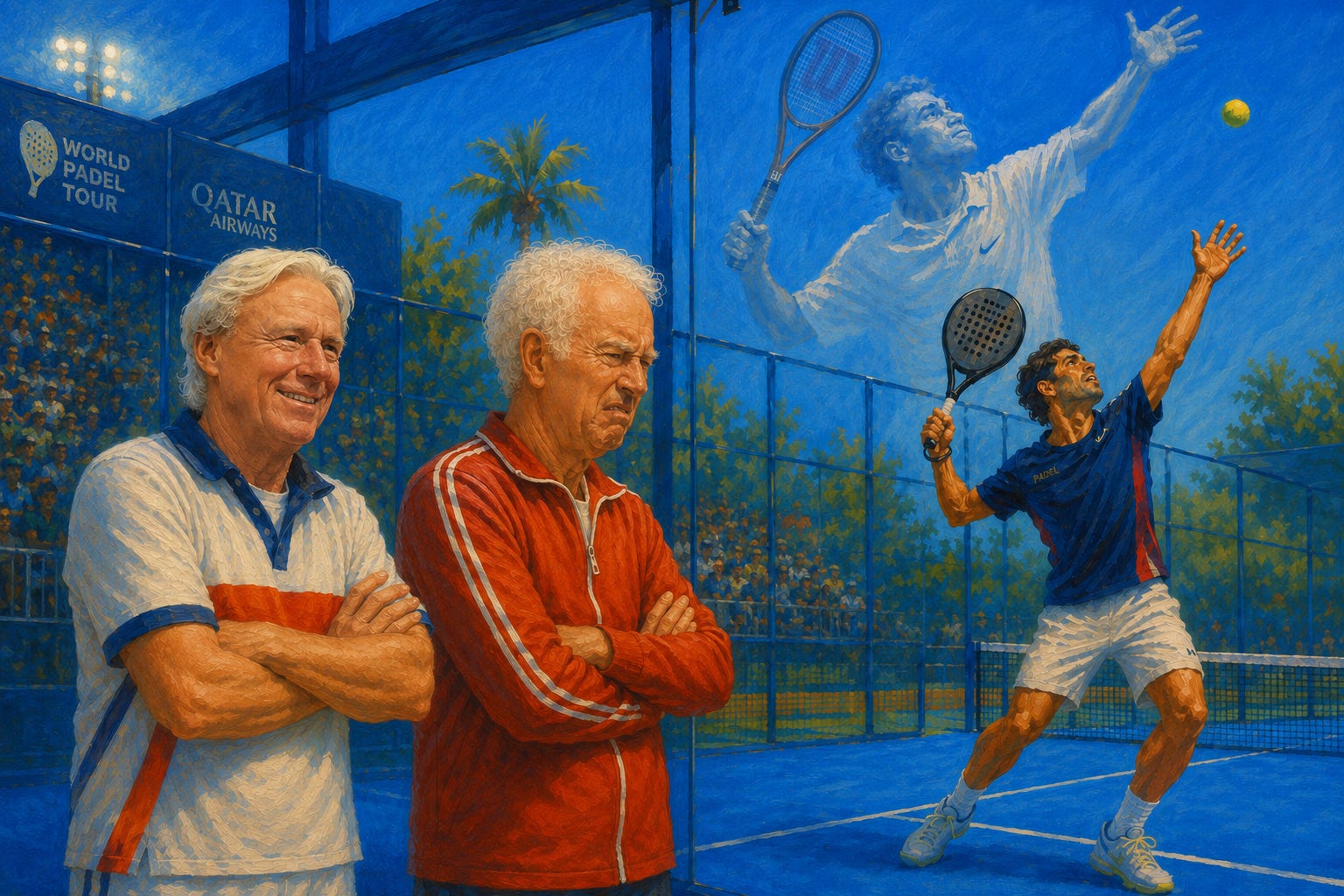
A few weeks ago, I was watching the Wimbledon men’s singles final and started thinking about the grass.
The pattern of dead grass on Centre Court pissed me off. As it does every year.
Through much of the 1990s, the grass was worn away around the net and in the spots where players landed after serving. Now, nearly everything between the service lines looks like a putting green, while the grass behind the baselines looks like the infield at Dodger Stadium.
The pattern reflects how dramatically the way that tennis is played has changed. Jannik Sinner and Alexander Zverev play a completely different game than the one John McEnroe and Björn Borg played in the 1981 final, which is still my favorite Wimbledon final.
McEnroe has long blamed racket technology for pushing tennis away from the net. Way back in a 2013 ESPN conference call, he said:
“Now you got kids six, eight, whatever, I see them at my academy all over the place, that swing for the fences … Totally discouraged at even the thought of coming to net because the point is over before they get there. They don’t even get the strategy or buildup of the idea of positioning yourself to move forward.”
I agree with him. The magic of tennis for me was always the contrast in styles. Because of the geometry of the court, the limitations of the equipment and the physics involved, players had to use guile and strategy and employ different shots based on the conditions of the match they were playing. They continually adjusted to the surface, the weather, the opponent and whatever was happening on court.
I’m sure Darren Cahill, who is the best coach out there, and Sinner have skull sessions to decide how Sinner will approach each match. But the reality is that Sinner wins by wailing topspin groundstrokes from the baseline. It works because every other player on the tour has to play the same way, and Sinner is way better at it than all of them. And he’s better on every surface because the surface no longer matters as much as it once did.
Modern players are super skilled, and not only that, they’re bigger, stronger, faster and fitter than their predecessors. They sometimes hit amazing shots, and a lot of people love to watch them play. But, overall, I don’t find the modern game as compelling as the previous version, when a grinder like Harold Solomon could find himself across the net from McEnroe playing “Once more unto the breach” tennis and have to figure out a way to win. I still watch, but I hardly ever last a whole match. The Match in 15 Minutes on Tennis Channel is about the right length. You kids get offa my lawn.
My buddy Julian, who destroyed me all through high school, played Division I college tennis and spent a few years on the pro tour, has completely abandoned watching the sport that defined our childhoods:
“I don’t watch tennis on TV or in person anymore because it’s boring and tedious. All the players play virtually the same style. Baseline bash, bash, harder, harder. Every point looks the same. I loved tennis from 1975 to 2000. The players then had distinctive playing styles and complete, all-court games. I loved the contrasting styles, the players figuring out their opponents, how they constructed points and the thinking you could see going on.”
For the record, I have always played the club-player version of the power baseline game, complete with a two-handed backhand. I can’t volley at all. But I appreciate watching players who can. Players with great footwork and better hands who construct points two or three shots ahead, who lob, chip and charge, drop shot and even, if you can believe it, charge the net on a regular basis.
Luckily, another racket sport, pickleball, still features players who play that way. Dig the third-shot drops, dink wars, blocked drives, chipping and charging and point construction! Just like tennis before graphite, Luxilon and Gustavo Kuerten. Right?
Wrong.
“You’re two years behind,” Josh Kerns from IAPPF, a trade association for pickleball and padel club operators, told me, or rather admonished me. “Pickleball isn’t changing. It’s changed. You will still see third-shot drops, but predominantly you will see a lot more drives. Everybody hits the shit out of the ball from beginners all the way up. But that’s a story that has been told ad nauseam.”
Kerns traced the shift to the arrival of thermoformed paddles, which gave players substantially more power and stability. Those paddles didn’t eliminate the dink game, but they made aggressive drives and speedups more effective and more common than they used to be.
Scott Colebourne, CEO and Executive Director at USA Padel and co-founder of PICKLESTARS™, Wow. Pickleball is on the same road as tennis. I just missed it.
Because I’m not a pickleball guy. I’m a padel guy now! Surely padel players are not winning matches bashing topspin groundstrokes. The walls will not allow it. I myself have to be really careful about hitting overheads because my buddies will be standing on the other side of the net ready to play the rebound into my groin. Which is embarrassing.
Still, a bunch of the same materials that changed tennis, including graphite, carbon and fiberglass, are showing up in padel rackets now. Many of those rackets have become stiffer, harder and more attack-oriented. Babolat describes Juan Lebrón’s Viper 3.0 racket as combining 3K carbon, a hard EVA core, a diamond shape and a reinforced central stability system to produce “explosive power,” responsiveness and greater stability at impact. It also says the raised texture on the racket’s surface helps generate spin.
Sound familiar, Mr. McEnroe?
I decided to ask people inside the sport whether technology is changing padel the way it changed tennis. René Lewicki, Wilson’s West Coast padel rep, said this:
“I think the game has changed considerably in recent years and has become much faster and more aggressive tactically. Many professional players can now smash from virtually anywhere on the court. The traditional bandeja is becoming less common, and some players are even chip-and-charging returns or starting at the net when receiving serve. In my view, however, this evolution is driven more by the athletes than the equipment. Players are becoming faster, stronger and taller, and an increasing number of tournaments are played indoors, where the controlled conditions favor more aggressive play.”
Uh-oh. It kind of sounds like padel might be doing the big-power thing, too. Or maybe not. I asked Scott Reddick of my home club, P1 Padel, what he thinks. Reddick is a tennis player as well as one of the smart young minds in padel. He said he believes technology has changed padel, but without changing its basic identity.
“Newer rackets make players more powerful and precise, but they haven’t replaced the fundamentals,” he told me.
Reddick believes technology’s larger impact may be on the overall padel experience. Better glass has improved visibility. Court and turf systems have become more consistent. Modern rackets can make the game easier to learn. Booking and social platforms help clubs create communities and fill courts.
In other words, technology may be making padel easier to enjoy and easier to scale commercially without fundamentally altering how players must play to win points.
Okay. I can live with that.
But here’s the thing. I know that tennis’s powers-that-be were not unaware that technology had altered the way the game was played. Pete Sampras’s serve was basically unreturnable, which was not fun to watch. As far back as 1992, the Associated Press reported that the International Tennis Federation’s Rules Committee was studying ways to reduce the dominance of the big serve. The possibilities included limiting racket power, regulating the technology used in rackets, balls and court surfaces, raising the net and changing the foot-fault rule to prevent servers from jumping.
They airballed. First of all, they did not address the strings. Then, instead of backing up the tech, they decided to tweak the balls and the court surfaces. Those tweaks threw out the baby with the bathwater because they affected not just the serve but just about every other shot as well. And now it’s almost impossible to serve and volley.
They airballed. The ideas they considered in 1992 went nowhere. A few years later, the ITF limited racket length to 29 inches, but it never imposed a broader limit on racket power or seriously rolled back the technology that was changing the game.
Pickleball’s governing authorities appear to be taking the threat seriously. They have begun developing tests and limits for paddle power, rebound characteristics and spin. Padel does not appear to be doing the same thing—at least not publicly. USA Padel’s Scott Colebourne told me:
“I do think it’s interesting that the technology in pickleball rackets has become so regulated and has finally changed the game to the point where it’s becoming dangerous in many people’s minds. There are restrictions on the material of the racket and the condition of the racket, whereas in padel the regulations on the racket are restricted to size.”
The published FIP rules cover dimensions and several other design and safety requirements, but I found no limits on racket power, rebound or spin. I also couldn’t find any published material showing that anybody is asking how much power is too much. People say the walls mitigate power. But the same walls that offer some constraint on hard hitting can also encourage it. What happens if rackets become so powerful that even amateur players can routinely end points by hitting the ball out from anywhere on the court?
If that happens, will players still be able to lob? And if not, what then? In padel, the lob is not merely another shot. It allows a team to move opponents off the net and recover the attacking position. Will the lob in padel go the way of the volley in tennis, steroids in baseball and wooden driver heads in golf? If players can’t lob, wouldn’t that fundamentally change the way padel is played? At what point does improved attacking power stop expanding the sport and begin narrowing it? Consider that, Mr. McEnroe.
Without the ability to lob, will players start hitting their returns and groundstrokes harder? Will they employ heavy topspin because nobody is regulating surface friction or spin potential? I would. Will players start hitting swinging topspin volleys, like they do in tennis, featuring so much topspin that they bounce off the back wall and out of the court?
Settle down, says USA Padel’s Colebourne. Padel is okay.
“Smashing the ball or unlimited power is not that helpful in padel,” Colebourne says. “Placing it more accurately is more helpful. Now, on the overhead, for sure, more power is better, but the majority of players out there are not executing their remate well enough to hit a por tres or por cuatro, and the power is not having that big of an impact. So, as a result, we have not seen an explosive change in racket power and technology. Maybe it happens in the future, but, you know, the material, the equipment is different from tennis and pickleball, and, as a result, we don’t have the same kind of power issues that they do for 99% of the players out there. For sure, Tapia, Chingotto, Galán, Lebrón, Bea González and Paula Josemaría—for them, power makes a big difference. But for the other 99%, it does not have as big an impact as it does in these other sports.”
That is reassuring to me. Tennis asked the wrong questions. And once equipment manufacturers, professional players and recreational players had adopted modern rackets and strings, meaningful restrictions became commercially and financially difficult.
Pickleball seems to be waking up to the danger and asking the right questions. But is it already too far down the road to power over all else?
I hope the people running padel are asking the right questions.
Because I like padel the way it is. And I really do not want to have to trot out my two-handed topspin backhand to the padel court.
First published on Scott Matulis Padel.
Read it on Substack