
I Tried TYPTI—and Found a New Sport That’s Great for Tennis Players
The first standalone TYPTI Racquet Centre just opened at The Village, a popular outdoor walking mall in Woodland Hills, CA.
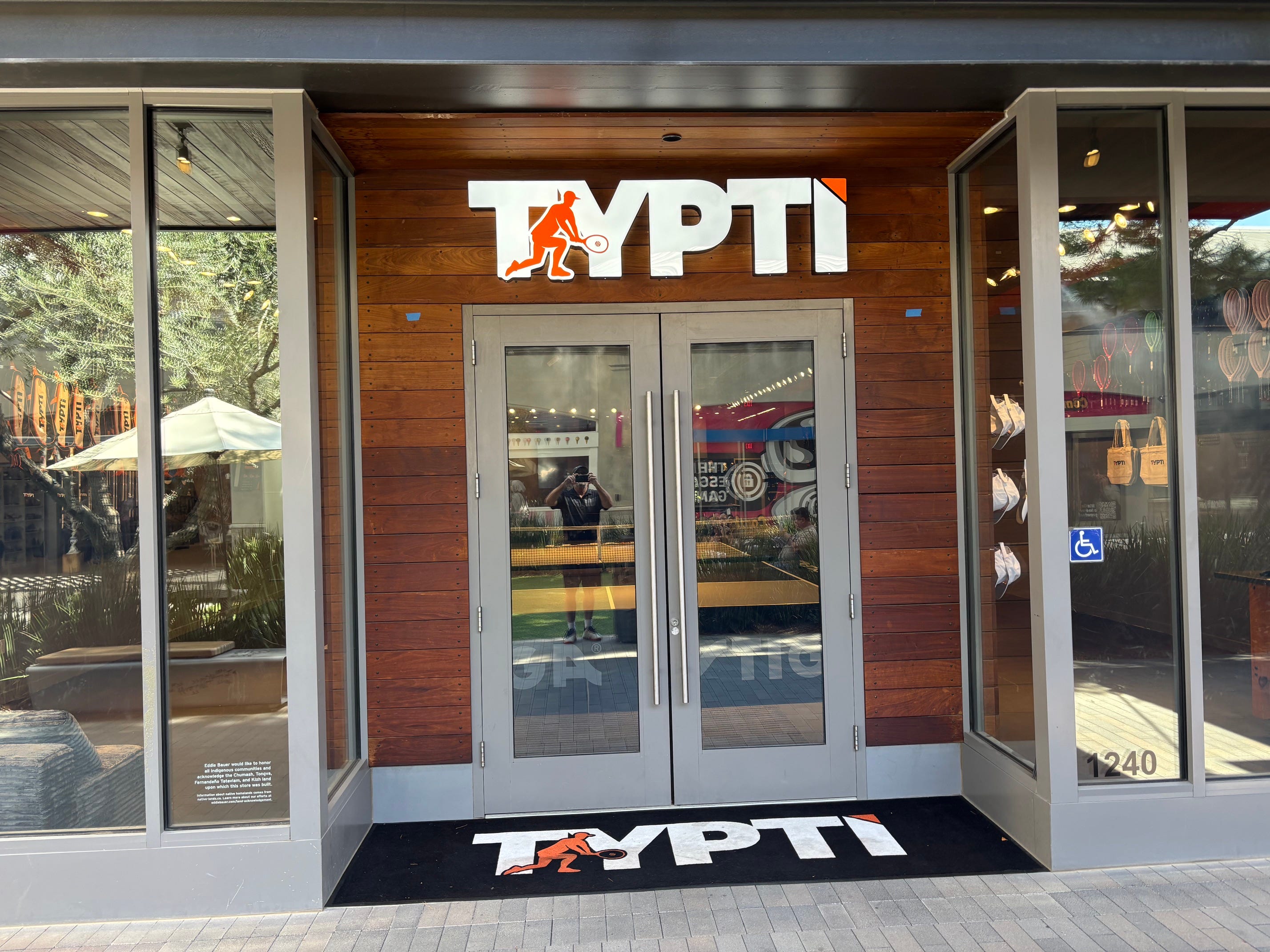
The first standalone TYPTI Racquet Centre just opened at The Village, a popular outdoor walking mall in Woodland Hills, CA. TYPTI founder Steve Bellamy, the guy behind the Tennis Channel, leased a space that used to be an Eddie Bauer store and replaced the waterproof boots and barn jackets with an entry point for people to learn the new sport he created. The Tennis Channel was a smart idea. Bellamy believes that TYPTI is even smarter.
His pitch to the mall was that he could bring in foot traffic while promoting TYPTI and other racket sports at the same time. But will it work? Will tennis players who want to learn TYPTI brave the mall traffic and parking garage to play there? Will Calabasas moms who come to the mall to buy shoes and ankle bracelets see the Centre, wonder what’s going on and walk in to check it out? Will they stay and play? Bellamy is betting they will.
It’s a unique idea, so I figured the next time I was in LA, I’d check it out.
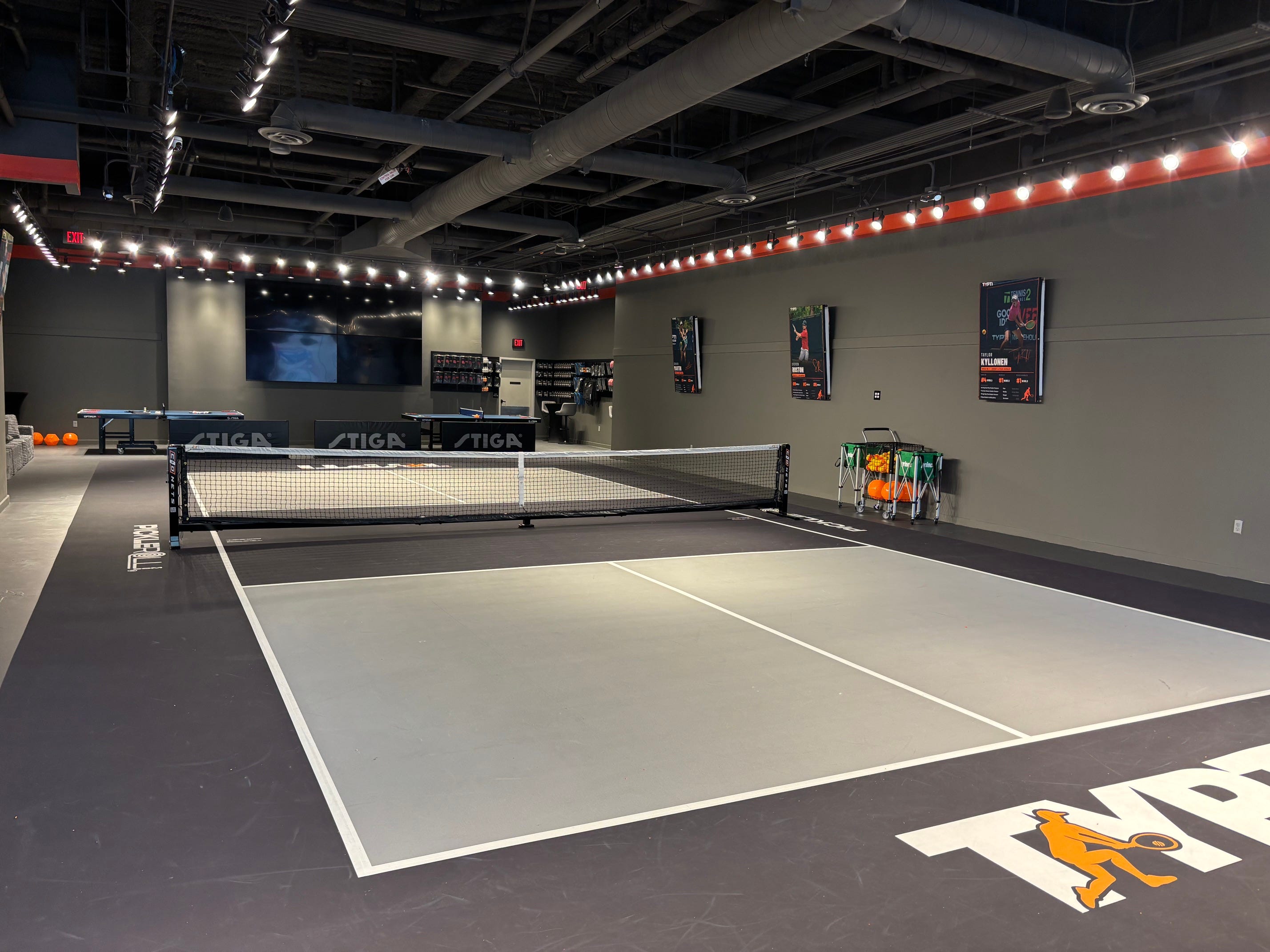
I showed up just after lunch on a Friday. The TYPTI Racket Centre sits within easy walking distance of the main parking structure. I spent a few minutes checking out the space and taking pictures with my phone. There’s a pristine PickleRoll TYPTI court complete with a premium C&D pickleball net, two STIGA ping pong tables, table tennis merch, and TYPTI rackets, racket bags, and TYPTI merch hanging on the walls. They’ve got couches and other seating on both sides of the room so people can hang out before and after they play.
The walls are lined with posters of top TYPTI players including Bellamy’s son Lincoln, currently ranked No. 1 among the men, and former WTA player Ashley Harkleroad, ranked No. 2 among the women.
After a moment, Kyle Verdi, who helps run TYPTI and was overseeing the Centre that afternoon, emerged from the back and introduced himself. I told him I was a big-time journalist, that I’d spoken with Bellamy and asked if he’d hit a few balls with me, which he agreed to do.
While Verdi went to get rackets, I reached into a hopper and grabbed one of the foam balls TYPTI uses instead of tennis/Wiffle/padel balls. It instantly reminded me of a round version of those kitchen sponges with foam on the inside and some kind of tough scrubbing surface on the outside. It looked to be about one and a half times the size of a tennis ball and felt a bit heavier than I’d anticipated. The bounce height seemed comparable to a padel ball.
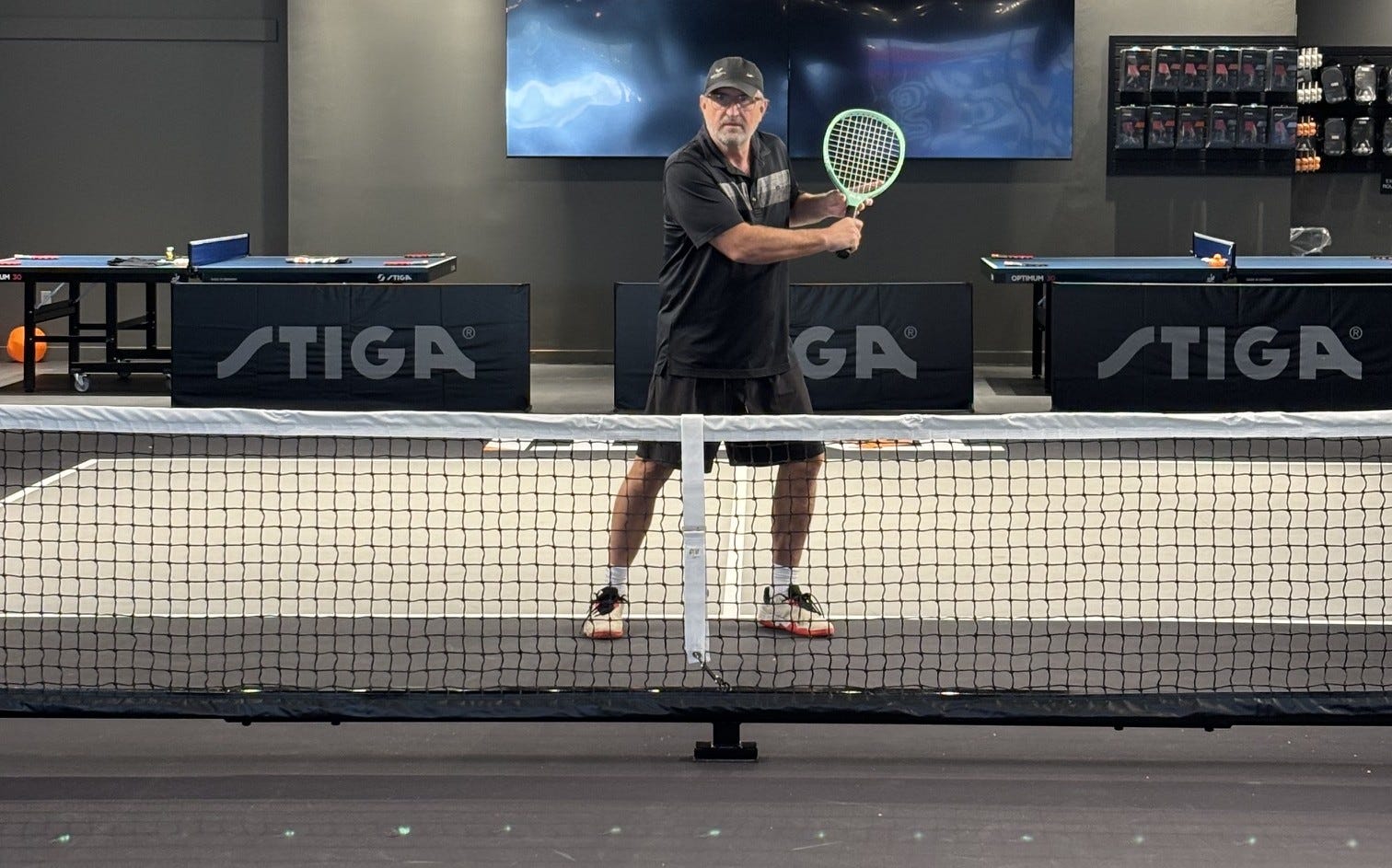
I was curious about the rackets, which, from the videos I’d watched, looked similar to kids’ tennis rackets. But when Kyle handed me one, it felt solid, like a player’s racket. It was also heavier than it looks. TYPTI currently sells two versions, the OLO da Vinci and the OLO Renoir, in a variety of colors. Bellamy told me that there are two more OLOs launching shortly as well as three models from Prince Tennis. Both current models cost $199, which honestly seemed a bit steep when I first saw the price tag.
Kyle handed me a green da Vinci, which weighs in at 9.5 ounces, strung. That’s roughly 16% lighter than my Yonex EZONE tennis racket, and 26% lighter than my Bela V3 padel racket.
The Da Vinci was strung with 15-gauge string in a wider-than-tennis string pattern featuring 10 mains and 11 crosses. It was strung at 35 pounds, more or less. It felt surprisingly like a tennis racket, which allowed me to get comfortable right away. The strings delivered a ton of bite, considerably more than I get with a padel, POP tennis or pickleball racket, and pretty quickly I was able to swing out on my groundstrokes while generating enough spin to keep them inside the baseline. The $199 was looking pretty reasonable at that point.
Bellamy says that the ability to hit hard is one of the big attractions of TYPTI.
“You load. You explode. You rip. You’re taking big, ripping swings. What I wanted was for TYPTI players to have the ability to launch missiles at one another with their feet flying off the ground on ball strikes. We nailed it.”
The lighter, shorter racket allowed me to ditch my two-handed backhand and rip Federer-esque one-handers, which made me (understandably) cocky. Okay, it was really just a basic one-handed backhand, but at that point I started looking over my shoulder to see if any passersby from the mall had stopped to watch.
I think part of the appeal of this sport to people who already play tennis is it allows you to hit shots that no way could you hit on a tennis court. That Alcaraz-like crosscourt forehand? An Edberg-esque volley? Even if you can’t hit them in tennis, with a bit of practice, you’ve got a solid chance with TYPTI.
Bellamy himself said: “I can’t hit a one-handed topspin backhand to save my life in tennis, but I’m Tommy Haas in TYPTI.”
At the net, volleys felt a bit weird initially and I was out in front of everything. But after hitting a dozen or so, I slowed myself down and realized I would eventually be better at the net in TYPTI than I am on a tennis court.
Unfortunately, however, in TYPTI you serve underhand and the serving team has to wait for the ball to bounce once on their side before they can volley, so serve-and-volley is not going to be a thing. Like with pickleball, it will be the returners chipping and busting ass to the net.
Honestly, I’m still not sure how I feel about the foam balls. I mean, they’re grippy, they do the job and they’re thankfully not the Wiffle balls they use in pickleball, but they’re not like the balls I’m used to hitting. Admittedly, 15 minutes is not enough time to acclimate to the bounce. But my tennis friends refuse to play pickleball because of the Wiffle ball and I wonder if the foam balls will keep them from giving TYPTI a shot. Hopefully not.
In addition to the balls, one of the things that makes TYPTI more than just mini tennis is the scoring system. Verdi and I played a couple of games so he could run me through it, and honestly, I picked it up pretty quickly. The scoring itself is based on winning points consecutively rather than on accumulating them. Win a point and you’re 1-Up. Win the next and you’re 2-Up. Win a third and you take the game. Lose at 1-Up and the score swings to 1-Down. 3-Down wins the game for the returner. Win five games and you win the set.
“When you start playing it, there are literally stakes from point one,” Bellamy told me. “It is so much better and so different. Every point matters.”
The biggest thing that makes TYPTI not mini tennis, and the thing I hope I can eventually figure out, is that players don’t have to hit the ball with their racket, or specifically with their strings. You can return serve with your hand or volley with your forehead—not necessarily because either is advisable, but because both are legal. I’m guessing as time goes on, players will realize that the strings are the best way to achieve pace, spin and accuracy, but knowing that there are other options makes things interesting.
As if winners off your forehead aren’t enough, if you happen to hit the ball into the net, you can, if you can reach it in time, hit it over the net and extend the point, as long as you don’t use your strings.
“Why should hitting the net be a death sentence? It isn’t in volleyball,” Bellamy explained. “When you see somebody make a net rebound in TYPTI, it’s glorious. We’ve broken every rule, and it’s been perfect. We have a couple more things we’re going to change that are pretty significant. They’re going to have every tennis fan going bananas.”
TYPTI’s the only racket sport I’ve played that lets you hit the ball with your body. It’s going to take me a good long while to adapt. It reminds me of playing balls off the wall in padel. By the time I realize I need to do it, it’s too late. Plus, I can’t imagine being fast enough to get up to the net in time. I guess we’ll see.
Only time will tell whether the TYPTI Racquet Centre catches on, but Verdi told me so far, so good. “We had the grand opening ribbon cutting just this past Sunday. We had more than a couple hundred guests here for it, and lots of demos, exhibitions, and all those sorts of things, as well as a viewing party for the US Open men’s singles final. I would say that we had a fair amount of people that didn’t know anything about the sport, that just walked in, and said, ‘What is this? I want to try this. It’s just incredible.’ They start playing, and they fall in love with it very quickly.”
TYPTI joins an ever-growing field of racket sports that, by design or not, give aging tennis players like me a chance to keep competing, keep hitting balls, without having to absorb the level of punishment you get trying to cover a full-sized concrete tennis court. You can play it on any pickleball court, so toss rackets and a few balls in your trunk and you’re good to go pretty much anywhere, at least in SoCal.
Foot traffic was light when I stopped by the TYPTI Racket Centre on Friday. But I’ve been there on weekends when it’s more crowded than the 405. LA folks are always looking for something new, the life-extending ice plunge or weight loss magic, and TYPTI might be it. Hanging out at the TYPTI Racquet Centre could be the next big thing. I like the odds. Bellamy believes in the concept and is planning additional mall outlets elsewhere.
“This is the first of what is likely a very franchisable model, so we are going to work overtime and obsess over the customer experience to make it amazing,” Bellamy said. “They (malls) are dying to keep the retailers they have, so they need things that draw people there. That’s what I’m pitching them, and as they migrate from retail to experiential, we’re going to lever that paradigm to promote racquet sports along the way. I want to have hundreds around America.”
First published on Scott Matulis Padel.
Read it on Substack